What are the smartest animals in the world, and how do we know?
Research shows many members of the animal kingdom rival our own.
Check out some of these smartie pies, courtesy of SentientMedia:
African Gray Parrots are thought to be one of the most intelligent species on the planet, rivaling even apes. In some areas, they surpass the abilities of five-year-old children. The reason, scientists believe, is that they can use deductive reasoning to solve problems, specifically determining which of two cups contains a food reward. More advanced versions of the same test revealed the parrots’ ability for logical thinking. In one such experiment, Griffin, the test subject, outperformed five-year-old children when it came to understanding concepts of certainty versus possibility.
Chimpanzees have been subjected to countless hours of research with the goal of better understanding their cognition. The result is that we can confidently say that chimps are one of the most intelligent species on earth. Humans share 99 percent of our DNA with chimps, so this should come as no surprise. They can recognize themselves in mirrors, a key component to abstract thinking. More than that, they are able to recognize themselves on video, a skill humans don’t get until around four years old.
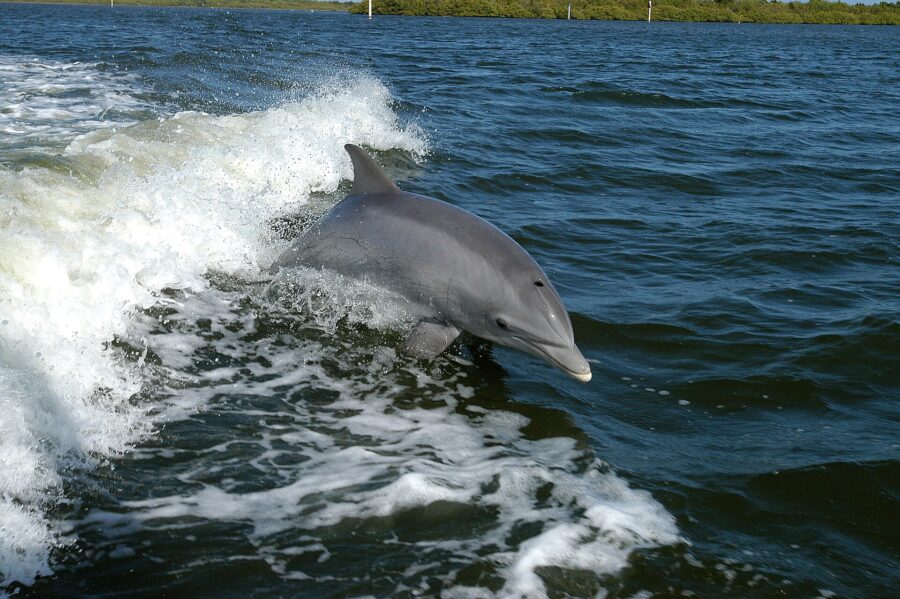
Dolphins are one of the most intelligent species on the planet; they are highly capable of both learning and mimicry. Even when they are in different pods, they use mud to create traps and use sponges for protection against coral as they search for food, demonstrating their ability to use tools and manipulate their surroundings. Dolphin pods are known to alter their hunting location and timing to adapt to or avoid new human activities, like construction.
Elephants never forget, the saying goes. Indeed, elephants can recall specific migration routes, and where to find water along the way. They can also differentiate between different groups of predators (including different groups of people) based on the way they smell and sound. They have been known to manipulate their surroundings to achieve their goal. For example, Kandula, an elephant housed at the National Zoo in Washington, D.C., used a block as a stepping stool to get to fruit outside his reach. It turns out, elephants depend on their senses of smell and touch far more heavily than humans or apes when interacting with their surroundings. As a result, they offered elephants sticks to use as tools, which elephants can only hold with their trunks, dampening their ability to touch and smell the world around them.
Octopuses are skilled escape artists, with some even escaping their enclosures and swimming all the way back to the wild. Their jailbreaking is less surprising in light of the fact that they have a larger brain-to-body ratio than any other known invertebrate species. They are adept at using tools sourced from their surroundings. Some species are known to carry the tentacles of the deadly jellyfish Portuguese man o’ war as a weapon, while others collect and carry coconut shells to build shelters for themselves.
Pigs are the classic example of an animal that surprises many people with their intelligence. In fact, they are so smart that they can play simple video games, as proven by four pigs at Purdue University’s Center for Animal Welfare Research. The game consisted of using a joystick to manipulate a dot that hit a wall. After hitting the wall, the pigs received a treat. All four pigs displayed skill far greater than would be expected by random chance. In order to play the game, the pigs had to understand that moving the joystick resulted in movement on the screen.
Ravens are extremely intelligent birds, and, in part because of it, they are associated with omens in many cultures. They have better planning skills than human toddlers. One study revealed that they could select a key from an array of objects that could be used to open a special box with a treat inside. They could find the correct key 90 percent of the time — and patiently wait a whopping 17 hours for the opportunity to use it to get a treat.
Rats have the ability to learn from experience, which has been harnessed by numerous experiments testing their cognition and reasoning abilities. One such test is the forced swim test, which has come under fire for being inhumane. Rats are capable of learning and recalling what the test consists of, meaning new rats — who have never been exposed to the test before — have to be used for each retest.
There are more: Ants, Bees, Cats, Crows, Dogs, Horses, Orcas, Pigeons, Squirrels, Wolves, the list goes on!
Click here to learn more: SentientMedia.org • thehumaneleague.org
Image: Wikimedia