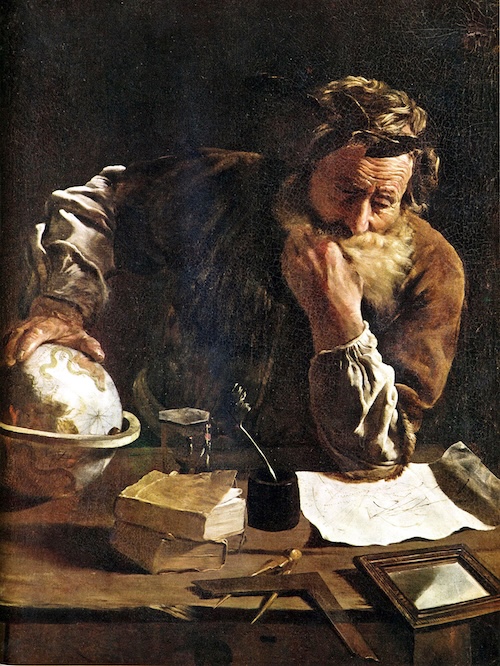
May 2026 — The art of invention: What do Brenden Sener (at 12), Archimedes, and a death ray have in common?
From Popular Mechanics magazine — “It might be surprising to learn that then-12-year-old Brenden Sener of London, Ontario was enthralled by Ancient Greek concepts. It makes more sense once you find out which legend grabbed him,” writes journalist Tim Newcomb in an article this month in Popular Mechanics. “Experts have credited the mathematician Archimedes with a weapon that could concentrate sunlight onto enemy ships: the death ray. And Sener wanted to know whether that story could hold up in the classroom.”
Tim notes that Sener, now 13, has earned multiple medals for his attempt to bring the ancient device to life, as described in his 2024 paper published in the Canadian Science Fair Journal.
Brenden’s experiment tested whether mirrors could concentrate heat—not whether ancient Syracuse fielded a working solar weapon. And there’s no archaeological evidence that proves that the death ray—also known as a heat ray—was ever used. The famous version of the story relies on later accounts, not on a clean contemporary record of the Roman siege of Syracuse. In the legend, the weapon used large mirrors—or sometimes polished shields—to focus sunlight onto Roman ships.
In his experiment: Brenden crafted a miniature version of the concept. He used a heat lamp and four concave mirrors, each pointed to hit a mark on a piece of cardboard. Presented at the 2023 Matthews Hall Annual Science Fair, he found that as he added mirrors, the temperature at the target location increased.
“The historical descriptions of the use of the death ray in ancient Syracuse are plausible,” Brenden has said, noting that no archeological evidence of Archimedes’ death ray has been found besides what is recorded in the books of ancient philosophers.
Brenden isn’t the first to explore Archimedes ideas. In 2006, the Discovery Channel’s MythBusters series tested scenarios three different times, but failed to make a boat catch fire. Experts believe that moving ships and clouds would limit the Sun’s heat and foil an attempt.
Learn more about Brenden here.
Learn more about Archimedes on Wikipedia: An Ancient Greek mathematician, physicist, engineer, astronomer, and inventor from the city of Syracuse in Sicily, few details of his life are known of Archimedes’ life. But based on his surviving work, he is considered one of the leading scientists in classical antiquity, and one of the greatest mathematicians of all time. Archimedes anticipated modern calculus and analysis by applying the concept of the infinitesimals and the method of exhaustion to derive and rigorously prove many geometrical theorems, including the area of a circle, the surface area and volume of a sphere, the area of an ellipse, the area under a parabola, the volume of a segment of a paraboloid of revolution, the volume of a segment of a hyperboloid of revolution, and the area of a spiral.
Click here to read the entire article by Tim Newcomb, a journalist based in the Pacific Northwest, who covers stadiums, sneakers, gear, infrastructure, and more for a variety of publications, including Popular Mechanics.
What have you invented? We want to hear from you! Click here to send an email with questions and ideas to Ellen Smith, editor, Inkandescent Kids magazine.