What is El Niño and La Niña? And how will it impact us this year?
A Note from the editors, Inkandescent Kids magazine — You likely have heard about the weather pattern called El Niño. It happens when surface water in the central and eastern Pacific Ocean near the equator stays warmer than usual for several months in a row. That extra warmth weakens the trade winds and pushes tropical rainfall eastward, which is the heart of the El Niño phenomenon.
Scientists tell us there is a twist behind the El Niño definition: Warmer water alone isn’t enough. The ocean and the air have to shift together to create the El Niño weather pattern, and you can’t spot it as a single storm on radar.
Keep these quick vocabulary terms handy:
- El Niño cycle: The repeating rhythm of warmer-than-usual Pacific water, a return to normal, and sometimes a cooler-than-usual phase called La Niño
- Pacific Ocean near the equator: The wide strip of ocean along the equator between South America and Indonesia, where El Niño kicks off
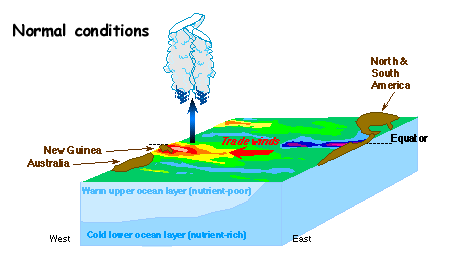
- Trade winds: Steady winds that usually blow from east to west across the tropical Pacific
- Surface ocean temperature change: A rise or fall in the temperature of the top layer of the sea that lasts weeks or months
- Changes in the air: Shifts in wind, clouds, and rainfall that show up alongside the ocean warming
- Remember this: El Niño is a recurring climate pattern that scientists can monitor and forecast, not a one-off weather surprise.
Click here to see how El Niño forms.
 What is La Niña?
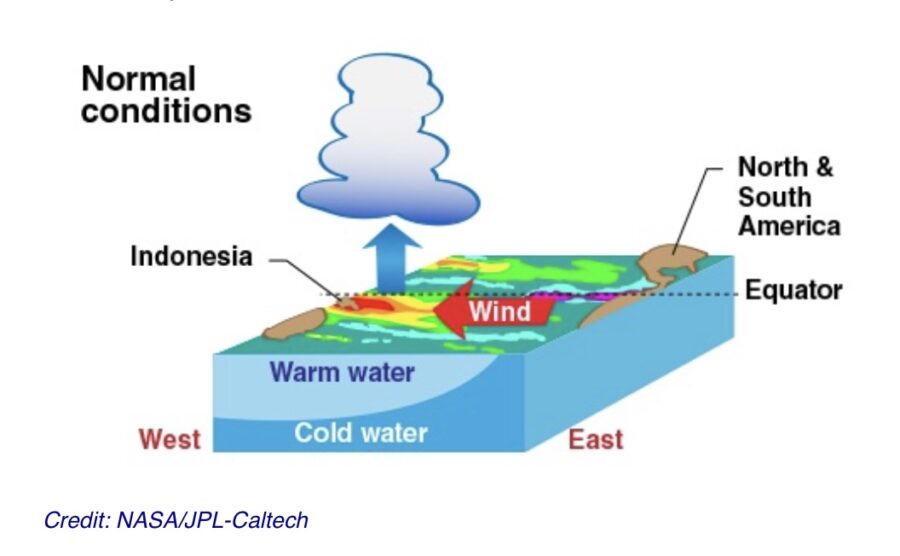
According to NOAA’s National Ocean Service, La Niña is a weather pattern that begins in the Pacific Ocean. Warm ocean water and clouds move west. This means that places like Indonesia and Australia can get much more rain than usual. And places like the southwestern United States can be very dry.
- The Winds: Normally, breezes blow across the Pacific from east to west. During La Niña, these winds get extra strong.
- The Warm Water: The wind pushes more warm water than usual toward the western side of the Pacific (near Australia and Southeast Asia).
- The Cold Water (Upwelling): Because the warm water leaves the eastern side (near South America), deep, cold water rushes up to take its place.
What It Does to the Weather: In a La Niña year, the winds above the Pacific Ocean are much, much stronger than usual. This usually happens once every few years. The winds are so strong during a La Niña (Spanish for “the girl”) that they push lots of warm ocean water west toward Indonesia. And that means that lots of cold water rises to the surface near South America.This makes the water in the eastern Pacific Ocean degrees a few degrees colder than usual. Even this small change in the ocean’s temperature can affect weather all over the world.
Learn more: spaceplace.nasa.gov