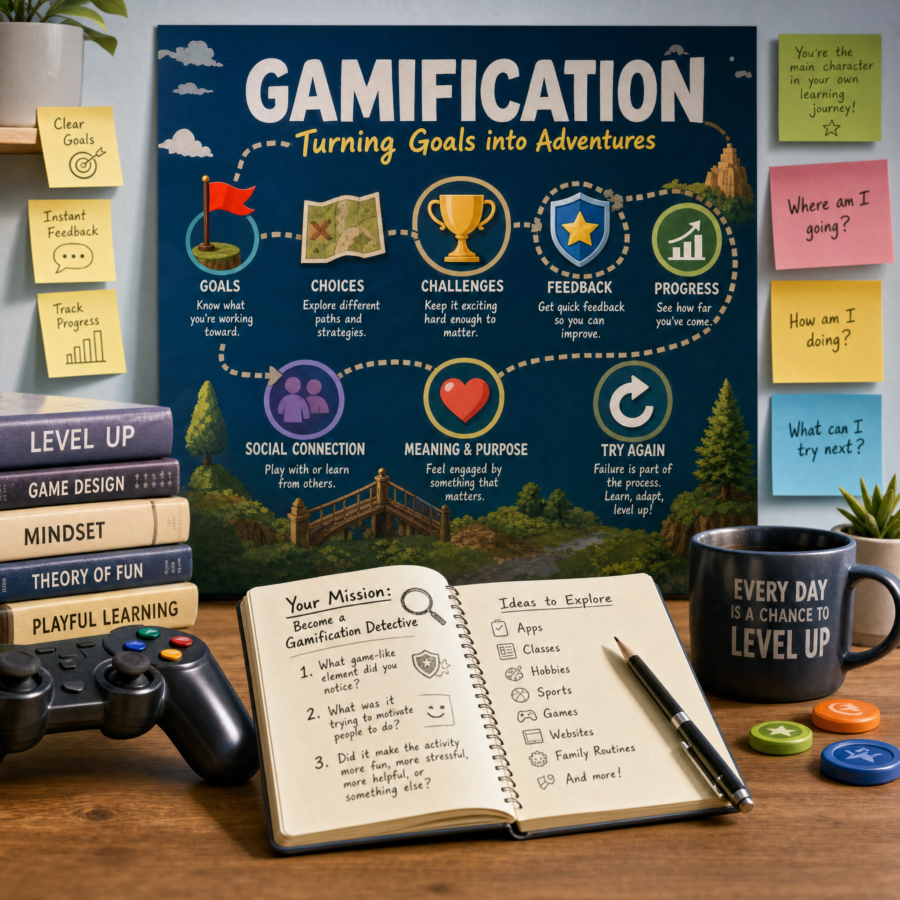
“Let’s Get Gameful,” by Valary Oleinik, Inkandescent Kids gamification columnist
One of my favorite activities for the past few years has been judging games for the Serious Play Conference. I have had the chance to play games used to protect workplaces from cyber-attacks, video games for K-12 students to learn just about every subject imaginable, board games for nurses and scientists, card games for mental health, and more. The possibilities for helping people to learn in engaging ways are only limited by our imaginations.
Last month I challenged you to become a gamification detective and to start looking for examples of gamification in the world around you. Did you do some detective work? What observations did you make?
This month we are going to continue investigating. We are going to look at ways to break games down to find out how they teach us to play them and what makes them engaging. Then we will also discover lessons that some famous and successful people took from playing games.
It’s not all about games, but it is about learning from them
We have already talked about the fact that gamification isn’t about making everything into a game, but one of the best ways to begin building your skills to gamify your learning and other parts of your life, is to play games. This month we are going to learn a way to explore games purposefully so we can gather ideas and information about how to create those gameful activities for yourself.
I set aside time each week to explore new games or gameful activities. Now, that is not just about getting to have fun and play, it is also really work. It is about analyzing things and coming up with creative ways to apply those results.
One way I analyze the games I play is to put them through a series of questions that help me to think more deeply about the game. I have given you a list of some of the questions that I use below. In this month’s challenge I will encourage you to go through this same investigative process on your own.
These questions and others help me to see the game in different ways. They let me reflect on how I learn the game, what I do or don’t like about it, and how others might respond to it (spoiler alert: we don’t all like the same things and what works for one person won’t for another). It also gives me new ideas about how I might combine different elements or activities to create more engagement for myself and those I design experiences for.
 Starter Questions for Purposefully Playing a Game
- Was it easy or hard to learn how to play the game? How did you learn to play (read instructions, played a tutorial, watched a video, learned from a friend, or some other way)?
- What, if anything, did you really like or dislike about the game?
- Was it visually appealing? If so, what types of things captured your attention?
- If it was digital, did it have sound? If so, could you play it with the sound off? How did that change your experience?
- How did you feel while playing the game?
- Would you want to play it again? Why?
- Was it clear what to do, where to go, and how you were doing in the game?
- Was there ever a point where you got stuck? What did you do?
- What were the various pieces, actions, visual elements, and challenges of the game?
- Did you pick up on anything about the design of the game that gave you an idea you could apply to one of your learning experiences?
What we can learn from video games
Before we move to this month’s mission I wanted to share a side quest I took this month. I spend a lot of time reading books about various topics related to my work with gamification. This month I read If Video Games Have Taught Me Anything: What Video Games Taught Some Of The World’s Most Fascinating People by Jon D. Harrison. The book contains a series of lessons that dozens of famous and successful people have taken from playing games. I am including a few quotes from the book to remind all of us that there is a lot to learn from video games that goes beyond the subjects like reading, math, history, and science.
“Not everyone plays fast, and not every challenge needs to be hard mode. Give yourself permission to play on easy, pause when you need, and move at your own speed. In games and in life.” Bruce Campbell, Actor/Director/Author
“[T]here’s no shame in stopping to ask for directions…. there are also moments where a little nudge or tip can mean the difference between giving up in frustration or getting unstuck and enjoying a unique experience.” David B. Fox, Game Designer and Programmer
“[D]on’t underestimate what you’re learning while you’re playing.” Marty Himmel, Web Developer
Take your own side quest and watch Jonathan Harrison’s TEDx Talk “How video games can empower real world success” from about a decade ago. Some of us have been learning from games for a long time.
Your Mission This Month
Play a game … purposefully.
Pick a video game, board game, or card game, preferably one you haven’t played before, to explore deeply.
- Reread the list of questions above so they are fresh in your mind.
- Just play the game like you would any new game for at least 20 minutes.
- Write down what you notice about the game. Answer at least five of the questions above.
- Find out what others say about the game by reading reviews or watching videos. What did others say about the game that you hadn’t considered?
- Play the game again and see if you find new insights and ideas that you could use in other parts of your life.
Level-Up Question
Think about one thing you want to learn or one thing you need to practice. What type of game or gameful solution might you be able to create to help you achieve your goal?

Gamification expert Valary Oleinik
About Valary Oleinik: Half geek and half artist and 100% committed to helping people develop and deliver more engaging and effective learning experiences, Valary lives by the motto “learners deserve better.”
Her decades of experience in workplace training and higher ed professional development and her innovative approach as a speaker and consultant on gamification of learning and creative problem solving have earned her the titles of “maven of new thinking” and the “MacGyver of training.”
Valary is the Owner and Chief Disruptor of DandeLearn llc, where she offers one-on-one coaching, as well as workshops and keynotes. She is Past President of USDLA (United States Distance Learning Association), and a certified facilitator of The BOX Experience, a proven methodology for those times when thinking out of the box is not enough. Throughout her endeavors, she is assisted by her cat and bunny who are lousy typists but great at shredding papers.
Learn more: valarywithawhy.com