What Is Gamification, Really?
By Valary Oleinik, Inkandescent Kids gamification columnist: valarywithawhy.com
Have you ever tried to keep a streak going? Maybe you practiced shooting hoops every day for a week or tried to make five baskets in a row. Each time you missed, you thought, “Just one more try.”
Or maybe you played a video game and unlocked an achievement, earned a badge, or reached a new level.
If so, you already know something about gamification. You also know something about the work I do as a gamification advocate.
As a gamification advocate, I study why games capture our attention and how some of those same ideas can help people learn, grow, and solve problems.
I have a career today that did not exist when I was in school. The key pieces existed, but they had not come together in quite the same way yet. The same may be true for you. You might have noticed that things are changing quickly these days.
That means learning how to learn, adapt, experiment, and keep going may matter even more than memorizing one “right” path.
One thing that has not changed, however, is that people like to play games. Humans have been playing games for thousands of years. But only in more recent times have people started taking gamification seriously in areas like education, business, marketing, fitness, and more.
Gamification is a weird word. It also has many different definitions, depending on who you ask. That is part of the reason people sometimes misunderstand what it is and what it is not.
So let’s clear up one big myth right away: gamification does not mean turning everything into a game.
It means discovering what makes games so engaging and using some of those elements in other types of activities. Games themselves are also being taken more seriously as learning tools that have value beyond just being played for fun.
For me, gamification is a rich collection of ideas, tools, and methods that can make learning more active, visible, and motivating. It can include games, game elements, playful challenges, progress tracking, storytelling, feedback, choices, and more.
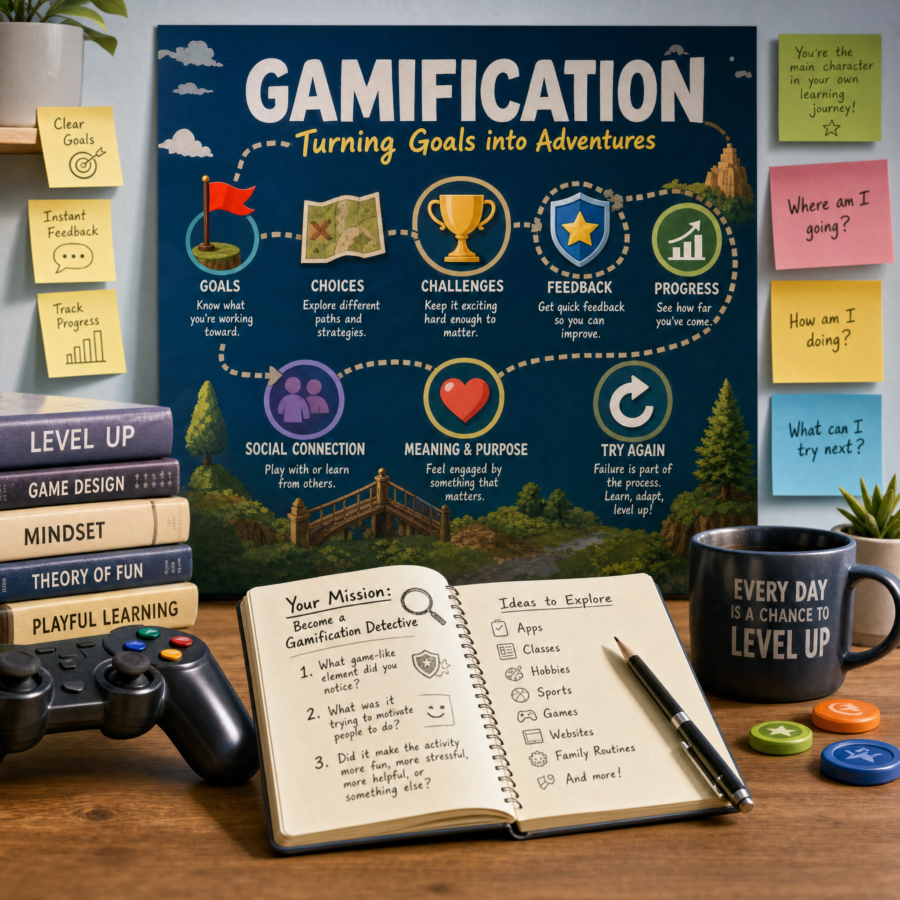
Think for a minute about what makes many games fun. A good game usually gives you a clear goal. It lets you make choices. It gives you feedback quickly, so you know how you are doing. It shows your progress. It may give you a chance to play with friends or against a digital opponent. It gives you challenges that are hard enough to be interesting but not so hard that you want to quit.
And when you mess up, the game usually lets you try again.
That last part is important.
In many games, failure is not the end. It is part of the process. You miss the jump, lose the round, pick the wrong path, or run out of time. Then you learn something and try again. You might change your strategy. You might practice a skill. You might ask another player for advice.
Learning can work that way, too.
That is one reason game designer Raph Koster referred to games as “deliberate practice machines” in his book A Theory of Fun for Game Design. A game or gameful environment can create a safe place to fail and try again. It can help you see mistakes as clues to follow, not proof that you are bad at something and should run away from it.
That is one reason gamification can be powerful. It helps turn passive learning into active learning. Instead of only reading, watching, or listening, you become part of the experience.
You are the main character in the game of your education.
You can set goals. You can make choices. You can try strategies. You can track progress. You can reflect on what worked and what did not. You can gain experience along the way.
And here is the best part: you can gamify almost anything.
Trying to read more books? Create a reading quest.
Working on math facts? Give yourself experience points for practice.
Learning about history? Turn events into a timeline challenge.
Cleaning your room? Make it a timed mission.
Practicing art, music, coding, writing, or sports? Track your levels as you improve.
Gamification is not about making learning silly or easy. It is about making learning clearer, more encouraging, and more engaging. It helps you answer three important questions:
Where am I going?
How am I doing?
What can I try next?
Those are great questions for games. They are also great questions for life.
Each month, we’ll explore one way games can help us think differently about learning. Then you’ll get a mission to try for yourself.
Your Mission This Month
Become a gamification detective.
Look for three examples of gamification in your everyday life. They might be in an app, a class, a hobby, a sport, a store, a website, a game, or even a family routine.
For each one, write down:
- What game-like element did you notice?
- What was it trying to motivate people to do?
- Did it make the activity more fun, more stressful, more helpful, or something else?
Level-Up Question
What is one thing you are learning right now that might be more interesting if you turned it into a quest, challenge, or progress tracker?

Gamification expert Valary Oleinik
About Valary Oleinik: Half geek and half artist and 100% committed to helping people develop and deliver more engaging and effective learning experiences, Valary lives by the motto “learners deserve better.”
Her decades of experience in workplace training and higher ed professional development and her innovative approach as a speaker and consultant on gamification of learning and creative problem solving have earned her the titles of “maven of new thinking” and the “MacGyver of training.”
Valary is the Owner and Chief Disruptor of DandeLearn llc, where she offers one-on-one coaching, as well as workshops and keynotes. She is Past President of USDLA (United States Distance Learning Association), and a certified facilitator of The BOX Experience, a proven methodology for those times when thinking out of the box is not enough. Throughout her endeavors, she is assisted by her cat and bunny who are lousy typists but great at shredding papers.
Learn more: valarywithawhy.com